Business Card Finishes Explained: What Makes a Card Look and Feel Premium?
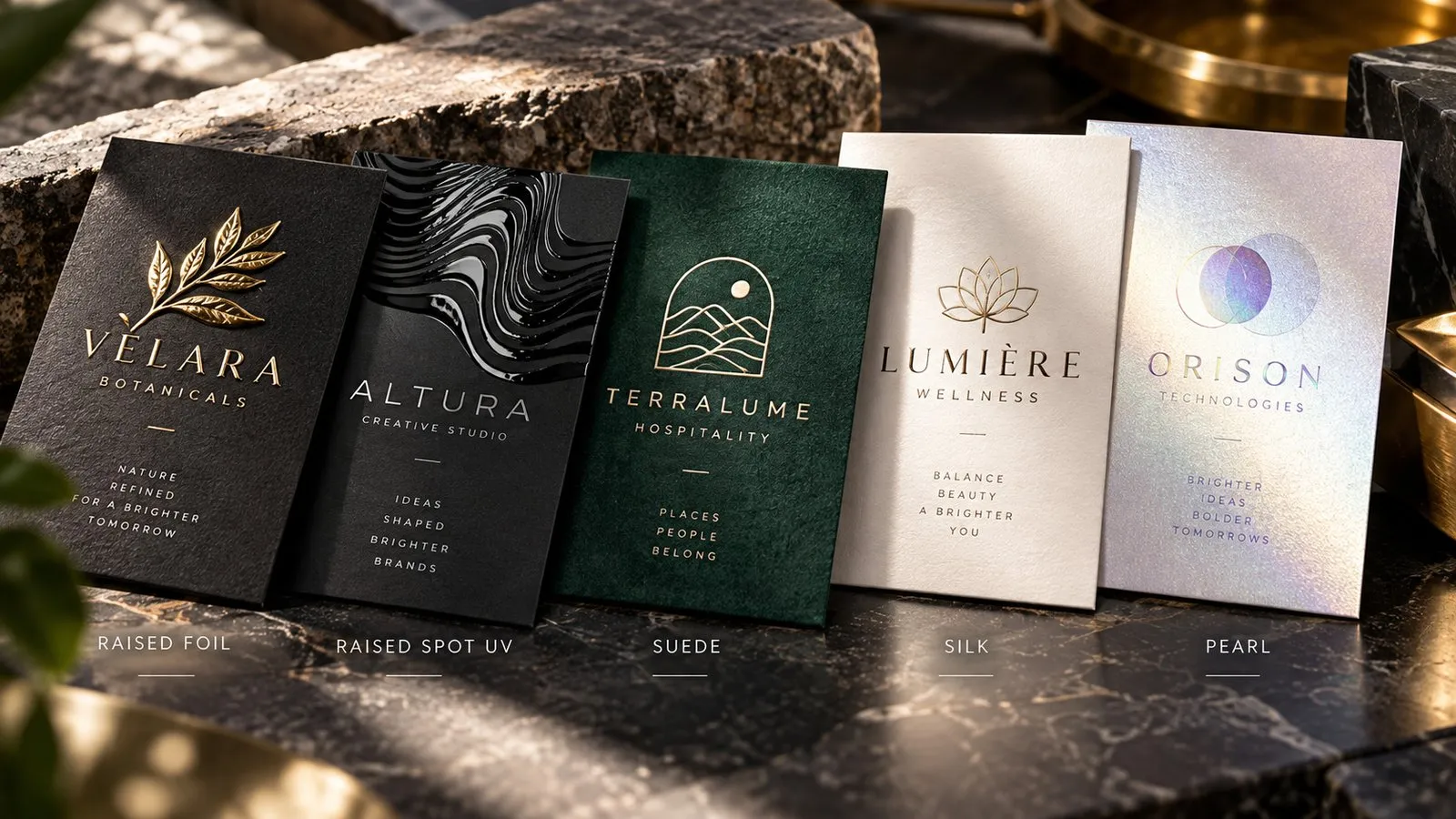
Watch someone take a business card from you. They read your name first. Then their thumb slides across the surface.
That two second thumb test tells them a lot. A thin, flimsy card says one thing. A thick card with a soft surface and a raised gold logo says something else entirely.
That's the job of business card finishes. A finish is the coating, laminate, or effect that changes how a card looks under light and feels in the hand. If you've ever wondered how to make business cards look premium, the answer usually isn't a bigger logo. Premium business cards get their character from the stock and the finish on top of it.
Below, we'll walk through the main premium business card finishes, how they compare, and what your artwork needs before any of them go to press.
What Are the Different Types of Business Card Finishes?
Most finishes fall into three groups.
| Group | What it changes | Examples |
|---|---|---|
| Coatings | How much the card shines | Matte, semi gloss, high gloss |
| Laminates | How the card feels | Silk, suede (soft velvet) |
| Raised effects | Height you can see and touch | Raised foil, raised spot UV |
Some papers, like pearl, have the effect built right into the stock.
Matte and gloss
Gloss coatings make colors bright and photos sharp. The tradeoff is glare and the odd fingerprint. Matte cuts the shine, so text reads easily under office lights and the card feels calm and modern.
Both are coated papers, meaning a thin layer was added so ink sits on top instead of soaking in. PrintWiki's entry on coated paper covers how gloss and matte coatings differ if you want the technical side.
Stock and texture
Card thickness is measured in points (pt). One point is one thousandth of an inch. Several of EverPrint's specialty cards start as 16pt stock and finish at 19pt once a laminate goes on both sides. People feel that weight before they read a word.
Raised Foil vs. Raised Spot UV: What Is the Difference?
These two get mixed up all the time. Both add height and both need a special artwork file. But they look very different.
Raised foil business cards use metallic foil that sits up off the surface, in gold, silver, or holographic. At EverPrint, the foil stands about 60 microns tall, so you can feel it with a fingertip. (Their flat foil option, Foil Worx, gives the metallic look without the raised feel.)
So what is raised spot UV on business cards? It's a clear, glossy coating applied only to chosen spots, like a logo or a pattern. On EverPrint's raised spot UV business cards, it stands about 50 microns high, far more texture than flat spot UV. The Foil and Specialty Effects Association describes raised UV as a way to add texture or an embossed look to a printed image.
Both cards sit on the same base: 16pt stock with a 1.5 mil soft velvet laminate on each side. That soft, matte background is what makes the raised areas pop.
| Feature | Raised foil | Raised spot UV |
|---|---|---|
| Look | Metallic gold, silver, or holographic | Clear gloss over your printed design |
| Raised height | About 60 microns | About 50 microns |
| Base card | 19pt, soft velvet laminate | 19pt, soft velvet laminate |
| Best for | Logos and names that should catch the light | Patterns, logos, or texture over color and photos |
| Sides | Front, or both sides | Front, or both sides |
The quick way to decide: raised foil when you want metal and sparkle, raised spot UV when you want your own design to shine through, just glossier and lifted.
Silk, Suede and Pearl: Which Texture Fits Your Brand?
Raised effects catch the eye. These finishes are about what the hand notices.
Silk and suede
Silk business cards at EverPrint are 16pt cards laminated on both sides. They have a smooth, matte look and resist water and tearing better than plain paper.
Suede business cards lean harder into feel. The soft velvet laminate brings them to 19pt and makes them feel almost like fabric. This is what most people mean when they ask for soft touch business cards.
One catch: that laminate softens colors and lowers contrast, so designs come out lighter and more muted. Great for calm, upscale brands. Less great if your brand lives on one exact, bright color.
So in the silk vs suede choice, silk is smooth and sleek, suede is soft and plush.
Pearl business cards work differently. The shimmer comes from the paper itself, not a laminate. EverPrint's Pearl Soft Touch cards use a 14pt metallic pearl stock that catches light from different angles. Heavy ink coverage can dull the effect, so pearl suits lighter designs with some open space.
How to Choose the Best Finish for Your Business Cards
The best finish for business cards depends on how the card gets used. Ask four questions:
- Will people write on it? Appointment and referral cards need a surface that takes ink.
- Do exact brand colors matter? If so, think twice about suede's muted look.
- Where will the card live? Wallets, truck dashboards, and job sites call for something water resistant.
- What should it feel like? Sleek, soft, shiny, or classic?
Here's how those answers often play out:
| If your business is... | A finish worth considering |
|---|---|
| Law, banking, or consulting | Suede with a raised foil logo |
| Real estate or interior design | Raised spot UV over a photo or pattern |
| Photography, retail, or creative work | Silk, or pearl with a light design |
| Contractors and field services | Silk for its water resistance |
| High volume handouts | Standard card with matte or gloss coating |
One more tip. Premium business card finishes work best when one effect is the star. A raised foil logo on suede looks confident. Foil, spot UV, and a busy photo on one small card looks crowded.
Why Artwork Preparation Matters for Premium Finishes
Business card artwork preparation is where most specialty orders go sideways. Usually it's not the press. It's the file.
Masks, bleed and safe margins
Raised foil and raised spot UV need two files: your regular print file plus a mask file. The mask is a simple map of where the foil or UV goes. At EverPrint, it must be vector artwork made in a program like Adobe Illustrator, using solid 100% black (C0 M0 Y0 K100) for the effect and white for everything else. No shadows, glows, or gray tones. Black means yes. White means no.
Then come the basics from EverPrint's artwork guidelines:
- Bleed: Extend backgrounds and images 1/8 inch past the trim line, where the card gets cut.
- Safe margin: Keep text and logos at least 1/8 inch inside the trim line.
- Resolution: Use images at 300 dpi or higher.
- Color: Set files to CMYK, the ink colors printers use. RGB files shift when converted.
- Fonts: Embed them or convert them to outlines. PDF is the preferred format.
Foil and spot UV rules are not the same
EverPrint lists different limits for each finish.
| Rule | Raised foil | Raised spot UV |
|---|---|---|
| Coverage | No more than 30% of the artwork | Under 30%, or up to 70% with patterns, thin strokes, or small shapes |
| Smallest text | 10pt (if smaller, lines at least 1pt thick) | 6pt, or 9pt for fonts with thicker strokes |
| Underneath | A solid color, no text or art | Your printed design |
Why the limits? Too much foil can look wavy. Too much raised UV can make cards stick together in a block.
Foil can also shift up to 1/16 inch when applied, so EverPrint advises against knockouts, which are gaps in the print meant to line up exactly with the foil. A tiny shift leaves a visible sliver.
If building mask files sounds like a chore, EverPrint's specialty business card design service handles it for you.
Final Checklist Before Ordering Specialty Business Cards
- One main effect chosen for the card
- Mask file is vector, 100% K black, and separate from the print file
- Foil or UV coverage stays within the limits above
- Small text meets the minimum size for your finish
- 1/8 inch bleed, with key content 1/8 inch inside the trim
- CMYK color, 300 dpi images, fonts outlined
- Proof checked against the mask before you approve
Business Card Finish FAQs
Can you write on glossy business cards?
It can be tricky. Ballpoint ink tends to smear or skip on a slick, high gloss surface. If people will write on your cards, matte or uncoated is safer. EverPrint's pearl cards can be written on with a Sharpie.
Are silk and suede business cards waterproof?
No. Both are water resistant, so a splash is fine but a soak isn't. Pearl cards are neither waterproof nor water resistant.
Can raised spot UV or raised foil go on both sides?
Yes. EverPrint offers both effects on the front only or on both sides.
Ready to Pick Your Finish?
Exploring business card finishes for your next project? EverPrint can help you compare specialty business cards, prepare the artwork correctly, and bring the final design into production.
Tell us how your cards get used, and we'll help you land on a finish that feels right the moment someone picks it up.